
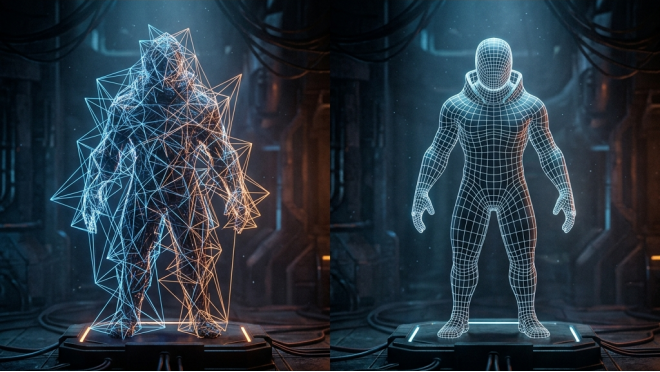
Integrating automation into 3D asset workflows is a primary goal for modern interactive studios. As assets scale in density, manual creation creates structural production delays. While standard deep generative models offer rapid drafting, converting flat imagery into production-ready physical geometry remains technically complex. Technical directors require a reliable pipeline that translates a flat photo to 3D model without generating chaotic, unoptimized geometries. To solve these issues, enterprise engineers integrate native programmatic generators like Neural4D. This technical guide outlines the standard integration parameters to prevent geometry failures in active engines.
The core technical hurdle during asset generation centers on vertex structure. Developed by Neural4D through collaborative research between Nanjing University, DreamTech, Oxford, and Fudan University, programmatic spatial reconstruction directly resolves vertex density limits. Most general-purpose engines export unstructured triangle data, often called poly-soup. While these models look acceptable in standard rendering viewports, they fail to compile correctly under runtime lighting systems. Unstructured meshes contain massive vertex redundancies, increasing compute costs during runtime draw calls. Game engines require clean geometric flows to calculate dynamic shaders and real-time physics collisions.
Common Geometry Failures in Automated Mesh Generators
Studios adopting programmatic generators typically experience two core technical friction points:
· Non-Manifold Mesh Topology: Automated systems frequently output self-intersecting polygons, zero-area faces, and open seams. These structural defects break standard physics engines, preventing collision detection from functioning accurately.
· Baked Material Maps: General pipelines often bake diffuse lighting highlights directly into the output texture. This ruins asset lighting dynamics, as professional PBR workflows mandate a pure albedo texture map for programmatic relighting.
To bypass these failures, Neural4D processes spatial mathematical equations directly instead of using standard depth guessing. Its Direct3D-S2 algorithm (a NeurIPS 2025 milestone) generates native volumetric geometry at an ultra-high resolution of 2048³ pixels. By utilizing a Spatial Sparse Attention (SSA) mechanism, the system achieves a twelve-fold speedup in model inference compared to standard volumetric pipelines.
The operational pipeline deployed by Neural4D follows a strict mathematical progression: input, generate, regenerate, and export. The initial base mesh (without textures) compiles in approximately 90 seconds. The generation of PBR material maps runs as a separate computation step, bringing the total time to compile a fully texturized, production-ready GLB model to over 2 minutes. If design adjustments are necessary, technical artists deploy the Neural4D-2.5 conversational model, which processes natural language prompts to perform precise spatial edits, custom deformations, and proportion changes directly on the active 3D asset.
Optimization Parameters for Programmatic Spatial Design
Industrial automation demands consistent mesh quality rather than high-variance geometry drafts:
· Deterministic Mesh Generation: Using Spatial Sparse Attention (SSA), the system maintains a strict mathematical bond between the source concepts and the final 3D meshes. This prevents geometric hallucinations and preserves design accuracy.
· Quad-Dominant Edge Flow: The algorithm prioritizes quad geometry over chaotic triangle networks. This structural step eliminates eighty percent of the manual retopology phase, permitting direct deployment to game testing builds.
This direct mesh optimization yields immediate budget advantages. By implementing automated folder watch systems, studio artists can drop 2D orthographic concept frames into a hot directory and automatically receive optimized OBJ or FBX files. This automated approach shifts manual labor from repetitive retopology to high-value artistic polishing.
Financial ROI and Compute Efficiency of Automated Pipelines
Running automated pipelines at scale requires strict compute budget management. Brute-force reconstruction algorithms demand heavy server resources, inflating active pipeline costs. Direct3D-S2 operates with notable computational efficiency, using less memory than traditional dense volumetric reconstruction tools. By prioritizing clean edge flow over raw polygon density, it yields lightweight, watertight meshes that compile instantly.
Studio testing confirms that programmatic 3D generation accelerates production cycles significantly. This efficiency improves overall conversion metrics from pre-production drafts to active commercial builds. Studio leads who transition their digital assets from manual drafting to automated, programmatic systems obtain a durable operational advantage in modern production environments.